

What Is Flippa and Who Is It For?
Flippa is an online marketplace where people buy and sell digital businesses: Shopify stores, content websites, YouTube channels, SaaS products, mobile apps, and more. If eBa is where you buy a used camera, Flippa is where you buy a small online business with real traffic and revenue.
It’s useful for a few different people:
- Buyers who want an existing business instead of building from scratch
- Sellers who have built something and want to cash out
- Investors who want to compare digital assets and spot undervalued deals
- Entrepreneurs who want to see what the market actually pays for online businesses
In this review, we’ll cover how Flippa works, the types of businesses you can find, what recently sold deals can teach you, how valuation works, how to sell, and a due diligence checklist for buying. We’ll also cover the downsides, because every marketplace has them.
What Is Flippa? How Does It Work?

How Flippa Connects Buyers and Sellers
Sellers create a listing with their business’s financials, traffic data, and description. Buyers browse listings, ask questions, make offers, and negotiate. Flippa sits in the middle with tools for valuation, messaging, escrow-style payment handling, and deal support.
What Types of Online Businesses Can You Buy or Sell?
You’ll find e-commerce stores, content sites, YouTube channels, SaaS companies, mobile apps, AI products, and other digital assets. The size range is wide, from small side projects to established businesses with serious revenue.
Is Flippa Suitable for Beginners?
Yes, with a caveat. The platform is easy to use, and the listings are structured so you can compare them. But buying a business is not like buying a gadget. A beginner can use Flippa comfortably, as long as they treat every listing as a claim to verify, not a fact to accept. We’ll cover how to do that in the due diligence section.
How Does the Flippa Buying and Selling Process Work?
Here’s the simple version:
- A seller lists a business with financials and traffic details.
- Buyers review the listing and ask questions.
- Buyer and seller negotiate price and terms.
- The buyer completes due diligence.
- Payment is handled through the platform’s transaction process.
- The seller transfers the assets (domain, accounts, code, content).
Each step has details that matter, and we’ll go through them below.
Why Flippa? Key Features and Benefits

Access to a Marketplace of Digital Businesses
The biggest benefit is simply choice. Instead of hunting for sellers through forums and cold outreach, you can browse a large number of listings in one place and filter by category, price, and profitability. Explore Flippa and See Opportunities Available.
Business Valuation and Market Data
Flippa offers valuation tools and market data that help both sides price a business in a more informed way. Sellers get a starting point instead of guessing. Buyers get context for whether an asking price is reasonable.
Buyer Matching and Deal Support
For sellers, getting in front of qualified buyers is half the battle. A marketplace with an active buyer base can shorten that process compared to selling privately.
Payment, Due Diligence, and Transaction Support
Moving money and transferring digital assets between strangers is where deals tend to go wrong. Having a structured transaction process, rather than a handshake and a wire transfer, lowers that risk. It doesn’t remove it, which is why your own due diligence still matters.
Flippa vs. Traditional Business Brokers
Traditional brokers often focus on larger, more traditional businesses and typically work on a fee or commission basis. Flippa is built for digital assets and lets you do much of the process yourself, with optional broker help for bigger or more complex deals. If you’re selling a small content site, a self-service marketplace may be enough. If you’re selling a seven-figure SaaS, professional help may be worth considering.

What Types of Businesses Can You Buy on Flippa?
Each category has different income sources and different risks. Here’s what to know.
Shopify Stores and E-commerce Businesses
Income comes from product sales. Look closely at supplier relationships, ad dependence, return rates, and profit margins. A store that only works because of one ad account or one supplier is fragile.
YouTube Channels and Content Businesses
Income usually comes from ad revenue, sponsorships, and affiliate links. The risks are platform policy changes, demonetization, and how much the audience depends on one personality.
Websites Monetized With Google AdSense
These earn from display ads. They’re simple to run but exposed to traffic swings, especially from search engine algorithm updates. Always check where the traffic actually comes from.
SaaS Businesses and Subscription Software
SaaS earns recurring subscription revenue, which buyers like. The key questions are churn, customer retention, and how much of the product knowledge sits in the founder’s head.
Mobile Apps and Profitable App Businesses
Revenue comes from in-app purchases, subscriptions, or ads. Review app store ranking stability, update history, and whether the codebase is maintainable.
AI Businesses and AI Apps
AI products can grow fast, but they also come with their own questions: Who owns the underlying technology? How dependent is the product on a third-party AI provider? How easy would it be for a competitor to copy it?
Health Apps and Digital Health Products
These can be valuable, but they carry extra weight around user privacy and regulation. If a listing involves health data, treat compliance as a core part of your evaluation.
Recently Sold Businesses on Flippa: What Can Buyers Learn?

Asking prices tell you what sellers hope for. Completed sales tell you what buyers actually paid. That’s why the “recently sold” view is one of the most useful parts of researching this market.
How to Find Recently Sold Businesses on Flippa
Flippa has a dedicated section for closed deals. Browse it by category to see what types of businesses are selling and at what prices. Explore recently sold businesses on Flippa.
Recently Sold Shopify Stores: What to Examine
Look at the revenue and profit when the store sold, how it was acquiring customers, and what the age of the business looked like. Compare similar stores, not just the headline price.
Recently Sold YouTube Channels and AdSense Websites
Check how long the asset had been earning, how stable the revenue looked, and what the traffic or audience source was. Stable, diversified income tends to be treated differently than a recent spike.
Recently Sold SaaS, AI Businesses, and Apps
For software, look at recurring revenue, growth pattern, and what kind of product it was. Compare deals within the same category, because software businesses vary widely.
What Completed Deals Reveal About Business Valuations
Completed deals show how the market values different kinds of income. Recurring revenue and consistent profit generally get more attention from buyers than one-time spikes. Use sold listings as a reference point, not a rulebook.
Asking Price vs. Actual Sale Price
The gap between asking price and sale price is where you learn about negotiation. If you’re a seller, it helps you price realistically. If you’re a buyer, it shows you where there may be room to negotiate.
How Much Is Your Online Business Worth?
What Determines the Value of an Online Business?
Value comes down to how much profit the business produces, how reliable that profit is, and how likely it is to continue after the sale.
Revenue, Net Profit, Growth, and Recurring Income
Buyers care about profit more than revenue, since revenue can hide high costs. They also look at growth trends and how predictable the income is. Recurring income, like subscriptions, is generally viewed more favorably than income that has to be re-earned every month.
How Business Valuation Multiples Work
A valuation multiple is simply the sale price divided by a measure of earnings, usually annual profit or sometimes revenue. If a business earning $50,000 a year in profit sells for $150,000, that’s a 3x multiple on profit. Multiples vary by business type, age, growth, and risk, so treat any multiple you see quoted as an example, not a rule. Always check whether a multiple is based on profit or revenue, and what kind of business it applies to.
Why Two Similar Businesses Can Have Different Valuations
Two stores with the same revenue can be priced very differently if one has stable customer acquisition and the other relies on one risky ad channel. Owner dependence, documentation, growth trend, and transferability all move the number.
How to Get a Free Flippa Business Valuation
If you want a starting point, you can use Flippa’s valuation tool. Get a Free Business Valuation. Keep in mind that a valuation is an estimate, not a guaranteed sale price. The final price depends on what a real buyer is willing to pay.

How to Sell Your Online Business on Flippa
Step 1: Prepare Your Financial Records
Gather profit and loss statements, revenue records, and expense details. Clean, accurate records build trust and speed things up.
Step 2: Organize Your Traffic and Revenue Data
Collect analytics showing traffic sources and trends, and tie them to revenue. Buyers want to understand where the money comes from.
Step 3: Create a Transparent Business Listing
Be honest and specific. Explain what the business does, how it earns money, and what the buyer will need to do to run it. Transparency builds credibility and reduces buyer drop-off later in the process. Sell Your Business on Flippa.
Step 4: Set a Realistic Asking Price
Use valuation tools and recently sold comparisons to price your business. An overpriced listing can sit unsold, while a fairly priced one attracts serious offers.
Step 5: Connect With Qualified Buyers and Negotiate
Respond to questions quickly and keep communication clear. Flippa also has a Buyer Directory that can help you reach potential buyers.
Step 6: Complete Due Diligence and Transfer the Business
Expect the buyer to verify your numbers. Have documentation ready, then follow a clear transfer checklist covering domains, accounts, code, and content.
Common Mistakes That Can Reduce Your Sale Price
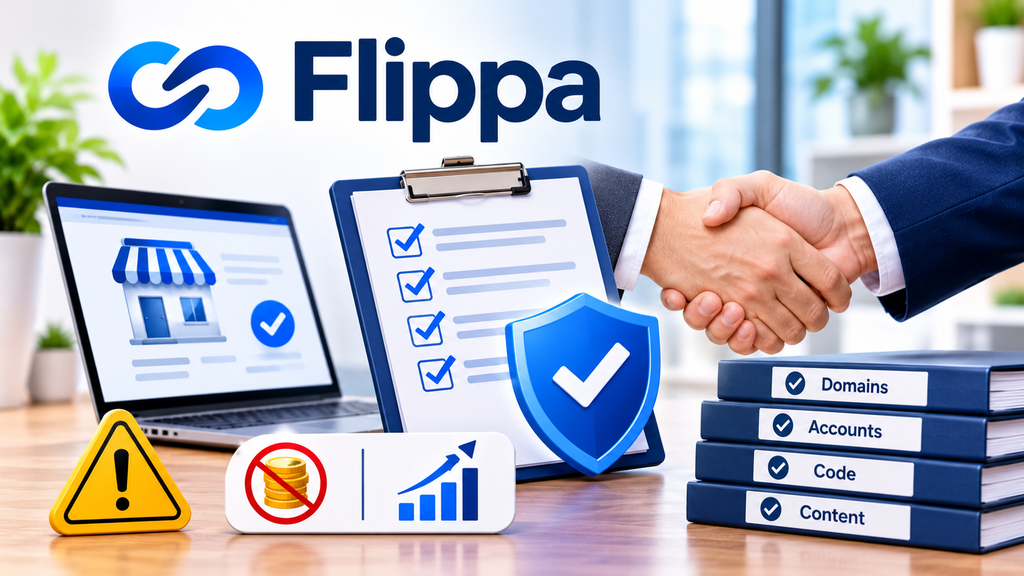
- Messy or incomplete financial records
- Overstating performance in the listing
- Ignoring owner dependence (if the business only works because of you, say so and plan for it)
- Pricing the business without checking comparable sales
- Slow responses to buyer questions
For larger or more complex deals, Flippa’s in-house business brokers can help. Broker services are optional and may come with conditions and fees, so check the details before deciding.
How to Buy a Business on Flippa: A Due Diligence Checklist
Buying a business means verifying claims. Use this checklist before you commit. When you’re ready to browse, you can explore businesses for sale on Flippa.
Verify Revenue, Expenses, and Profit
Ask for proof: payment processor records, bank statements, and accounting reports. Compare them against what the listing says.
Check Website Traffic and Traffic Sources
Confirm traffic through analytics access, not screenshots alone. Look at where traffic comes from and whether it’s stable.
Review Shopify, YouTube, and AdSense Monetization Risks
Check how dependent the income is on one platform, one ad account, or one policy. Platform rule changes can hit these businesses quickly.
Evaluate SaaS Churn, Customer Retention, and Recurring Revenue
For software, ask for churn rates, customer counts, and revenue breakdowns. High churn can quietly erode value.
Assess AI App Technology, Ownership, and Competition
Confirm who owns the code and any underlying models or data. Check how reliant the product is on third-party AI services and how easy it would be for competitors to replicate.
Review Health App Privacy and Regulatory Risks
If the product handles health-related data, review privacy practices and regulatory exposure. This is worth professional advice.
Understand Transferability and Seller Dependence
Ask what the seller does day to day and whether you can take over smoothly. Check that accounts, domains, and assets can actually be transferred.
Negotiate Based on Evidence, Not Promises
If you find issues, use them to negotiate price or terms. Base your offer on what you’ve verified, not on what the seller says the business could become.
Flippa Data Insights: Understand Market Demand and Valuations
Beyond listings, Flippa publishes market data that can help you make better decisions. Explore Flippa Data Insights.
Search Intent and Trending Business Categories
Data on what people search for can show which kinds of businesses are drawing attention.
Buyer Demand and Buyer Liquidity
Understanding how many active buyers exist for a category helps sellers judge how easy a sale might be.
Business Valuation Multiples and Comparable Sales
Comparable sales give context for pricing. As always, use them as a reference and check the details of each comparison.
Time to Sell and Market Trends
Knowing how long similar businesses take to sell helps you plan, whether you’re listing or budgeting time for a purchase.
How Sellers Can Use Data to Improve Their Listings
Use demand and comparable data to position your listing, set your price, and highlight what buyers in your category care about.
How Buyers Can Use Data to Compare Opportunities
Use the data to compare opportunities side by side and avoid paying for hype. Data supports evidence-based decisions, but it can’t predict whether any specific deal will work out.
Flippa’s In-House Business Brokers: When Should You Use One?
What Does a Business Broker Do?
A broker helps prepare a listing, find buyers, negotiate, and guide the deal through to closing.
Benefits of Professional Deal Preparation and Negotiation
Experienced help can make a listing more polished and keep negotiations on track, which can matter on larger deals.
Which Types of Businesses May Benefit From Brokerage?
Larger, more complex, or higher-value businesses are the most likely to benefit. If a business is small and simple, you may not need one.
Questions to Ask Before Hiring a Broker
- What experience do you have with my type of business?
- How are fees structured?
- What happens if the business doesn’t sell?
- What does the process look like from start to finish?
Broker Services, Fees, and Eligibility
Broker services are optional and may have eligibility requirements and fees. Meet Flippa’s Business Brokers and ask about the details. Whether it makes sense depends on your deal size, complexity, and budget.
Flippa Pros and Cons
Flippa Pros
- Large marketplace with many categories of digital businesses
- Valuation tools and market data
- Structured transaction and due diligence process
- Optional broker support for bigger deals
- Useful for both buyers and sellers
Flippa Cons and Potential Risks
- Listing quality varies, so buyers must verify claims
- Fees and conditions apply for sellers and for some services
- Easy to overpay if you rely on asking prices or hype
- Some businesses depend heavily on one platform, one traffic source, or the founder
- No marketplace can remove business risk
How to Reduce Risk When Buying or Selling
Verify everything, use comparable sales, avoid rushing, and get professional legal or financial advice for significant deals. Don’t base a decision on a single metric or a single data source.
Frequently Asked Questions About Flippa
Is Flippa Legit?
Flippa is an established marketplace for buying and selling online businesses. As with any marketplace, individual listings vary in quality, so you still need to verify what you’re buying.
Is Flippa Good for Beginners?
It’s beginner-friendly in terms of using the platform, but buying a business involves real risk. Beginners should start small, learn due diligence, and consider help on larger deals.
Can You Buy a Shopify Store on Flippa?
Yes, Shopify and other e-commerce stores are a common category.
Can You Buy or Sell a YouTube Channel on Flippa?
Yes, YouTube channels and other content businesses are listed. Be aware of platform-related risks.
Can You Buy an AdSense Website?
Yes, content websites monetized with AdSense are commonly listed. Check traffic quality and dependence on search traffic.
Are SaaS Businesses and AI Apps Available on Flippa?
Yes, you can find SaaS businesses, apps, and AI products. Review technology ownership and customer retention carefully.
How Can I Find Recently Sold Businesses?
Use Flippa’s dedicated page for completed deals and compare by category.
How Do I Get a Free Business Valuation?
Use Flippa’s valuation tool. Treat the result as an estimate, not a guaranteed sale price.
Does Flippa Offer Business Brokers?
Yes, Flippa has in-house brokers for qualifying deals, and their services may involve fees and conditions.
What Should I Check Before Buying a Business?
Revenue and profit proof, traffic sources, platform dependence, customer retention, technology ownership, regulatory risk, and how easily the business can be transferred.
Final Verdict: Is Flippa Worth Exploring in 2026?
If you want to buy or sell a digital business, Flippa is worth a serious look. It gives you a large marketplace, valuation tools, market data, and optional broker support in one place.
- If you’re a seller: start with the free valuation, then prepare your records and list with realistic pricing.
- If you’re a buyer: browse listings and recently sold deals to learn the market before you commit.
- If your deal is large or complex: consider whether a broker makes sense.
Whatever your role, the platform doesn’t replace your own financial and operational checks. Verify the numbers and understand the risks before you invest.
Ready to take a look? Explore Flippa, review available businesses, and find your next opportunity.